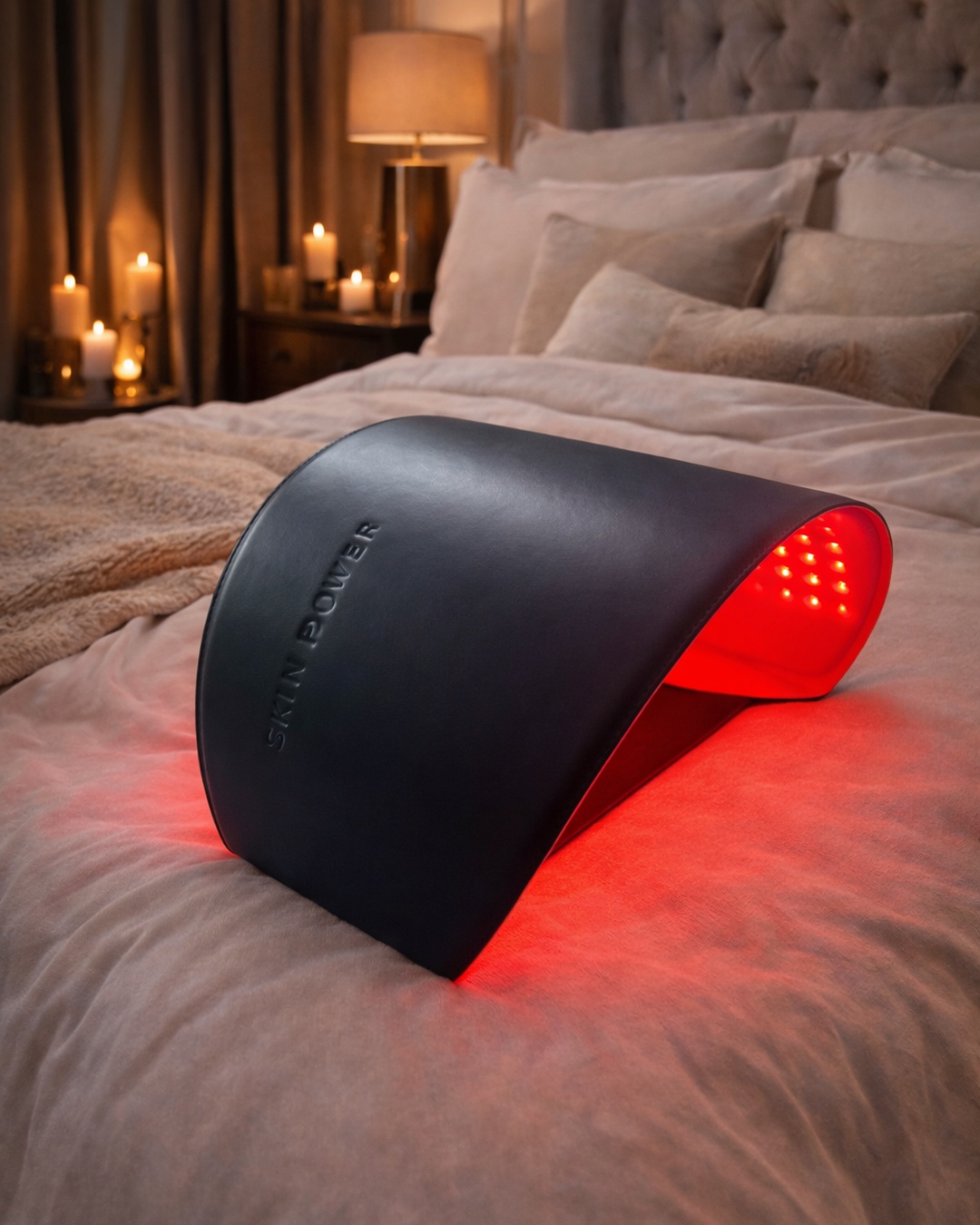
A quiet ritual can be grounded in thoughtful science. Here, we share peer-reviewed research exploring light therapy and microneedling — alongside what those findings can, and cannot, tell us about care at home.
An honest note on the evidence
These papers study technologies, not the Skin Power House products or complete rituals. They are not product-specific clinical trials, and their results are not a promise of the same outcome with our devices. We have not established equivalent trial evidence for our at-home systems.
Peer review and double-blinding are different: peer review is scrutiny by other researchers before publication; double-blinding aims to keep participants and outcome assessors unaware of treatment allocation. Only studies explicitly described as double-blind are labelled that way below.
01 · Light therapy
Light, and the skin’s response
Red and near-infrared light have been studied for changes in the appearance of fine lines, skin elasticity and collagen. The results depend on wavelength, light output, dose and treatment schedule — the colour of the light alone does not establish effectiveness.
Our LUMEA and INTEGRA rituals include LED light therapy. The studies below offer background on this technology; they do not validate every setting or colour on the Skin Power Repair LED system, or establish claims for redness or blemishes.
Skin Power Repair LED · our at-home light ritual
Lee SY et al. · 2007
A prospective, randomized, placebo-controlled, double-blinded, and split-face clinical study on LED phototherapy for skin rejuvenation
Journal of Photochemistry and Photobiology B: Biology, 88(1), 51–67. DOI: 10.1016/j.jphotobiol.2007.04.008
Study design: Randomised, placebo-controlled, double-blinded split-face trial involving 76 participants; 633 nm red light, 830 nm near-infrared light, or both.
The researchers reported improvements in measured wrinkles and skin elasticity, with tissue assessments showing changes in collagen and elastic fibres after a defined course of treatment.
Keep in mind: This used specified study equipment and doses, with a short treatment course and limited follow-up. Matching a wavelength is not enough to assume the same results from another device.
Light-emitting diodes in dermatology: A systematic review of randomized controlled trials
Lasers in Surgery and Medicine, 50(6), 613–628. DOI: 10.1002/lsm.22791
Study design: Systematic review of 31 randomised controlled trials across several skin applications; not a single double-blind trial.
The review brings together evidence for LED applications and identifies skin rejuvenation as an area with promising but limited evidence.
Keep in mind: Studies varied in size, blinding, dose and treatment settings. Findings for one skin concern or wavelength cannot automatically be applied to another.
Microneedling research explores the skin’s response to controlled needling. Much of the published evidence concerns professional treatments, including work on acne scars and facial rejuvenation, rather than shallow home-use rollers.
The Skin Power Glide used in VIGILĀ and INTEGRA has a 0.25 mm head. The professional-treatment findings below do not establish equivalent collagen, wrinkle or scar improvements from that depth, its combined LED and EMS settings, or the accompanying Exo-Serum. These papers also do not prove that needling makes our serum more effective.
Alam M et al. · 2014
Efficacy of a needling device for the treatment of acne scars: A randomized clinical trial
Study design: Small, randomised, placebo-controlled split-face trial with blinded outcome raters; not described as double-blind.
After a course of professional needling, the treated side showed improvement in acne-scar appearance at six-month assessment.
Keep in mind: The outcome was acne scarring, not everyday fine lines or hydration. It studied a professional procedure and does not support an acne-scar treatment claim for a 0.25 mm home device.
Study design: Systematic review covering 21 studies and 723 patients; not a single double-blind trial.
The review reports encouraging facial rejuvenation outcomes and patient satisfaction across the included studies, with wrinkles among the most frequently assessed outcomes.
Keep in mind: Devices, techniques and outcome measures differed across studies. These findings do not establish the same benefits for our specific at-home device or complete ritual.
Results and suitability vary. Follow your device’s instructions, including hygiene, eye protection and suitability precautions where required. Do not use needling on irritated or infected skin. If you have a skin condition, take medicines that increase light sensitivity, or are unsure whether a device is suitable, seek advice from a qualified healthcare professional before use.
This page is educational, not medical advice. Research reviewed October 2026. Your personal ritual guide remains available through the QR card included with your purchase.